



Belt Scale for Mining: What Accuracy Class Is Needed for Production Control?
Choosing a belt scale for mining is rarely just a metering decision. When production control depends on live tonnage data, accuracy class affects stock balance, blending stability, maintenance planning, and even incident prevention around overloaded transfer points.
In mining and bulk material handling, small weighing errors can become large monthly losses. That is why the right belt scale for mining should be matched to the control task, not selected by nameplate accuracy alone.
Why accuracy class matters in production control
The first question is not which model looks advanced. It is how the weight signal will be used in daily operation.
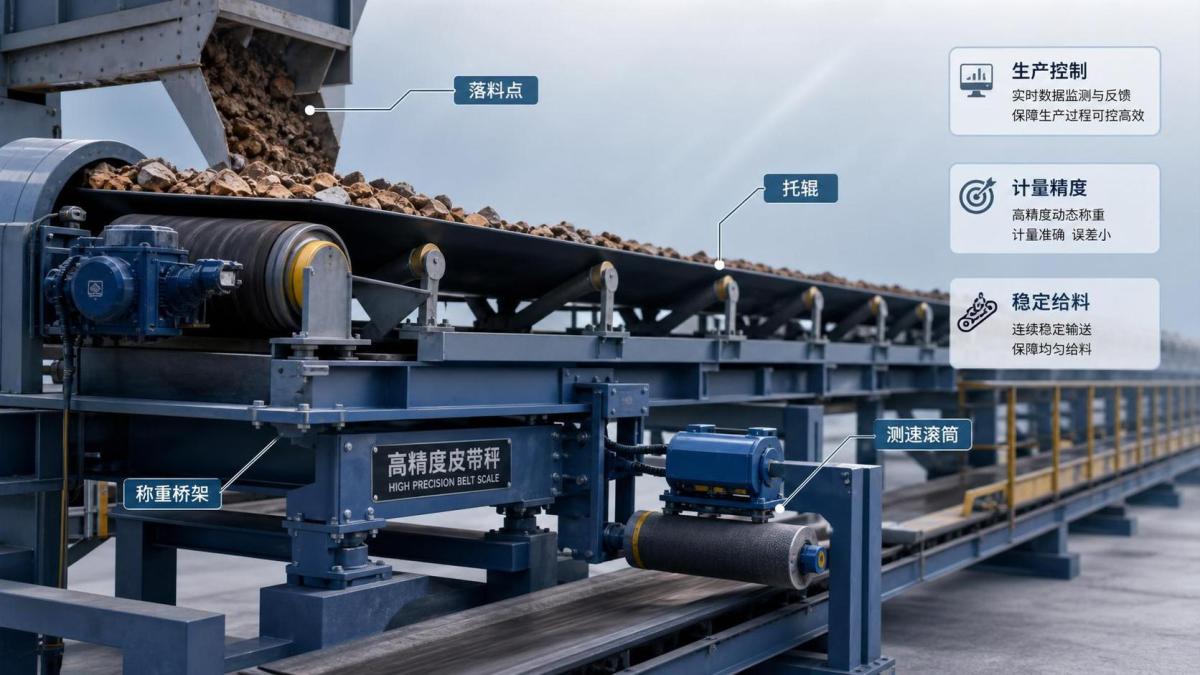
If the scale supports trend monitoring, a moderate accuracy class may be acceptable. If it drives blending ratios, dispatch planning, or contractual reporting, tolerance becomes much tighter.
A belt scale for mining measures moving material under changing loading, speed, vibration, moisture, and belt tension. Accuracy class describes expected performance, but actual field results depend on installation and operating conditions.
Different tasks require different accuracy levels
Production control covers more than one objective. Some lines need rough throughput visibility. Others need repeatable data for closed-loop control and reconciliation.
For many mines, a practical target for production control is not the highest possible class. It is the most reliable class that can be maintained consistently in the field.
What affects the real accuracy of a belt scale for mining
The scale frame and integrator are only part of the result. Mechanical conditions often decide whether a stated accuracy class is realistic.
Conveyor condition
Belt wander, uneven idlers, mistracking, and variable tension create unstable loading. Even a high-grade belt scale for mining will drift under poor conveyor geometry.
Material behavior
Large lump size, sticky ore, fluctuating moisture, and surge feeding all reduce repeatability. The feeder and transfer design must support smooth loading onto the weighing section.
Calibration discipline
Test chains and zero checks help, but regular material tests remain essential. A scale that is never verified cannot support serious production control.
How to match accuracy class to operational risk
A useful way to choose is to start from the cost of being wrong. In some circuits, a one percent deviation changes little. In others, it affects blend chemistry, crusher loading, or stockpile reporting.
- Use a moderate class when the scale is mainly for visibility and production trending.
- Use a tighter class when the signal feeds batching, blending, or automated setpoint correction.
- Require verified field performance when the data enters compliance records or internal settlement.
This is where the wider handling system matters. Weifang Yuansheng Magnetic & Electrical Equipment Co., Ltd. works across conveyors, magnetic separation, metal detection, electric vibrators, and microcomputer metering devices.
That broader equipment context is important because weighing accuracy is linked to feed stability, tramp metal control, and mechanical consistency across the line.
Points that deserve closer attention on site
When evaluating a belt scale for mining, several details usually have more impact than brochure claims.
- Straight, stable conveyor sections before and after the scale.
- Consistent belt speed measurement without slip or lag.
- Adequate protection from vibration transmitted by crushers or screens.
- Clean belt return and reduced buildup under idlers.
- Routine calibration based on actual ore conditions, not only empty-belt checks.
In practical terms, a lower nominal class on a well-prepared conveyor often performs better than a higher class installed on a disturbed section.
A practical way to move forward
The best belt scale for mining is the one that delivers dependable data under real operating conditions, with a maintenance routine the site can sustain.
A useful next step is to map the measurement purpose, acceptable error band, conveyor condition, and calibration method before comparing models. That approach usually leads to a more defensible accuracy choice.
Where feed uniformity is part of the issue, upstream equipment should be reviewed at the same time. For reference, the workshop application shown in Miniature Vibrating Feeder Workshop Production Scene is a helpful example of how stable material delivery can support better weighing consistency across a controlled handling system.
Search from here
Get Free Quotes