



Slurry Magnetic Separator Selection for Wet Processing: What Parameters Matter Most?
Slurry Magnetic Separator Selection for Wet Processing: What Parameters Matter Most?
Choosing the right slurry magnetic separator for wet processing can directly affect product purity, recovery efficiency, and operating cost.
The real challenge is not finding a machine with strong magnetism.
It is matching separator performance to actual slurry behavior, process targets, and site constraints.
In wet processing, small parameter gaps often lead to large differences in iron removal stability.
That is why a technical review should focus on measurable factors, not broad product claims.
This guide explains which parameters matter most when comparing a slurry magnetic separator for demanding applications.
Start with the Slurry Itself
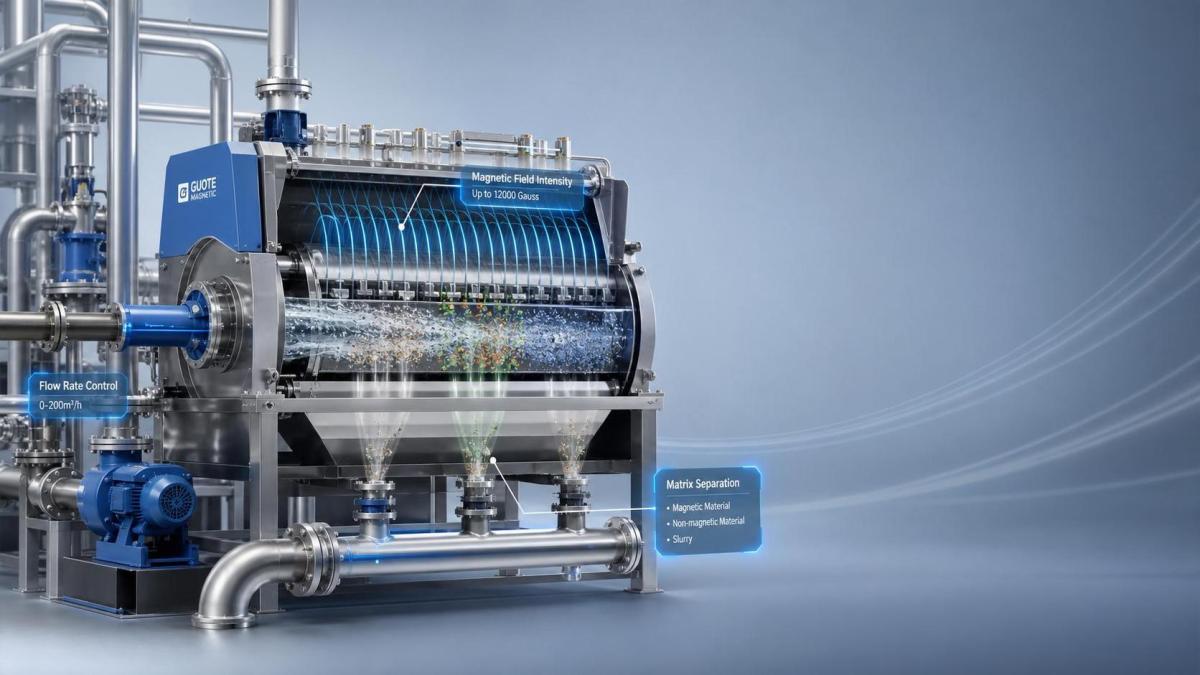
Selection begins with slurry properties, because the feed defines the separation window.
A slurry magnetic separator working well on one material may underperform on another.
First, check solids concentration.
Higher density slurries reduce flow freedom and can shield weakly magnetic particles.
Second, review particle size distribution.
Fine particles usually need stronger field intensity and better field gradient.
Coarser particles may separate more easily, but they can also increase wear and blockage risk.
Third, understand viscosity.
Viscous slurry slows particle movement and changes how contaminants approach the magnetic zone.
This also affects flushing efficiency during cleaning cycles.
A practical review usually includes these data points:
- Solids percentage by weight
- Particle size range and top size
- Slurry viscosity and temperature
- pH and corrosion tendency
- Type and amount of iron contamination
Without this baseline, slurry magnetic separator sizing becomes guesswork.
Magnetic Strength Is Important, but Field Design Matters More
Many evaluations stop at magnetic field strength.
That is useful, but it is only part of the picture.
For a slurry magnetic separator, the shape and distribution of the field often determine real capture efficiency.
Weakly magnetic contaminants respond better to a strong field gradient than to headline intensity alone.
This is especially true in ceramic, mineral, chemical, and battery material processing.
Ask for more than one value when comparing equipment.
- Peak magnetic intensity
- Effective magnetic area
- Field gradient near the matrix or working gap
- Field stability during continuous operation
In actual wet separation, stable performance matters more than a single impressive test number.
This also explains why two separators with similar ratings can deliver different purity results.
Flow Rate, Residence Time, and Throughput Must Stay Balanced
A slurry magnetic separator should match the line capacity without pushing slurry through too quickly.
When flow is too high, magnetic particles may not spend enough time in the active field.
When flow is too low, the line loses efficiency and operating cost rises.
The right balance depends on pipeline design, pump pressure, and slurry consistency.
This is where residence time becomes a key decision parameter.
Longer residence time can improve capture, but only if the flow path remains uniform.
Dead zones or bypass channels reduce the value of added time.
During evaluation, compare these operating indicators:
- Rated throughput under actual slurry density
- Pressure drop across the separator
- Recommended flow velocity
- Sensitivity to feed fluctuation
A good slurry magnetic separator should maintain separation quality even when feed conditions move slightly.
Matrix Design, Cleaning Method, and Maintenance Access Affect Real Uptime
One of the most overlooked selection points is the working matrix.
The matrix defines capture surface area and influences how fine iron is retained.
A dense matrix may improve removal efficiency, but it can also clog more easily.
That tradeoff becomes more obvious in high solids or sticky slurries.
Cleaning method matters just as much.
If iron discharge is incomplete, the magnetic zone saturates and performance drops over time.
In continuous plants, this can create hidden quality drift.
Check whether the separator supports efficient rinsing, quick cleaning cycles, and safe maintenance access.
This also affects labor input and unplanned downtime.
A technically sound choice is not only about removal rate.
It is about how long that removal rate can be sustained between service intervals.
Material Compatibility, Energy Use, and Control Precision Complete the Decision
Wet environments demand careful attention to construction materials.
Corrosion resistance is essential when slurry contains chemicals, salts, or abrasive fines.
Internal surfaces should also support stable cleaning and avoid contamination buildup.
For electromagnetic designs, energy consumption deserves close review.
Higher magnetic force may improve separation, but power demand and cooling requirements also increase.
The better question is cost per ton at target purity, not power alone.
Control precision is another useful differentiator.
Adjustable current, stable operating parameters, and predictable alarm functions make performance easier to manage.
This becomes more valuable when product specifications are tight and feed quality varies day to day.
A Practical Selection Checklist for Wet Processing
To compare a slurry magnetic separator with confidence, use a short decision checklist.
- Define the iron removal target in ppm or final purity terms
- Match field strength and gradient to particle size and magnetic susceptibility
- Confirm rated throughput under real slurry conditions
- Review matrix structure for both capture and cleanability
- Check materials, corrosion resistance, and wear exposure
- Estimate energy use, cleaning frequency, and maintenance time
- Ask for test data based on similar wet processing applications
This approach keeps the evaluation technical, comparable, and grounded in operating reality.
For projects needing guided equipment comparison, Weifang Yuansheng Magnetic & Electrical Equipment Co., Ltd. offers wet processing solutions across magnetic separation and related process equipment.
A useful starting point is the YSDCS Series Wet Electromagnetic Slurry Iron Remover, designed for slurry-based iron removal where stable purity and controllable operation matter.
When the slurry magnetic separator is matched to real feed parameters, the result is usually better product quality, steadier recovery, and lower total operating cost.
Search from here
Get Free Quotes