



Dry Magnetic Separator vs Wet Magnetic Separator: How to Choose by Material State
Choosing between a dry magnetic separator and a wet magnetic separator starts with one practical question: what state is the material in when it reaches the separation stage?
If the feed is dry, free-flowing, and sensitive to water addition, a dry magnetic separator is usually the stronger fit.
If the material is already in slurry form or requires fine-particle recovery with better dispersion, wet separation often delivers higher efficiency and cleaner results.
For technical evaluators, the decision is not just about equipment type. It directly affects purity, recovery rate, downstream handling, operating cost, and plant stability.
This guide explains how to compare dry and wet magnetic separation by material state, particle behavior, process targets, and practical operating constraints.
What Technical Evaluators Should Assess First
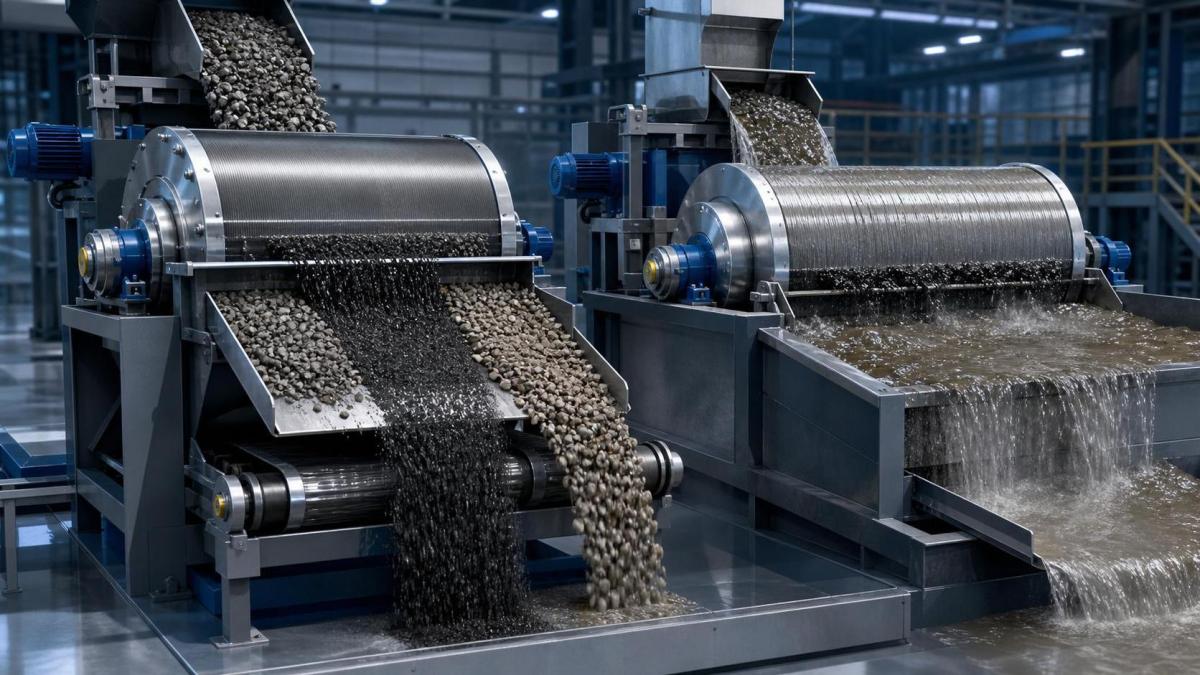
When evaluating a dry magnetic separator, the first priority is to define the actual condition of the feed rather than relying only on ore category or material name.
Moisture content is the main starting point. Even slightly damp material can reduce flowability, increase particle adhesion, and weaken separation consistency in dry systems.
Particle size distribution is the next critical factor. Coarse and medium particles are often easier to treat in dry mode, while ultrafine particles usually respond better in wet processing.
You also need to confirm the separation objective. Removing tramp iron, upgrading concentrate grade, and recovering weakly magnetic fines do not require the same separator design.
In many assessments, the wrong machine is selected because the review focuses on magnetic strength alone instead of total process conditions and separation goals.
When a Dry Magnetic Separator Is the Better Choice
A dry magnetic separator is generally preferred when the feed is dry, granular, and capable of moving through the magnetic field without sticking or agglomerating.
This approach is common in pre-concentration, impurity removal, and dry powder handling where adding water would create extra process steps or disposal issues.
Technical evaluators often favor dry systems in plants where water is limited, slurry infrastructure is unavailable, or drying costs after separation would be unacceptable.
Dry separation also supports simpler plant layouts in some applications. It can reduce the need for pumps, thickeners, dewatering units, and water circulation management.
For bulk minerals, abrasive materials, and certain industrial powders, a dry magnetic separator can be a cost-effective solution when the feed condition remains stable.
Another advantage is easier integration into conveying and screening lines. This matters when the separator is part of a broader material handling system.
Where Dry Separation Has Clear Limits
Dry separation becomes less effective when moisture causes particles to clump together. Once that happens, magnetic and non-magnetic particles stop behaving as separate units.
This reduces selectivity and can increase contamination in both product streams. The result is lower grade, lower recovery, or both.
Very fine particles are another challenge. Fine material is harder to present uniformly to the magnetic field in dry mode, especially in high-throughput conditions.
Dust generation can also become a concern. In enclosed industrial systems, this may require additional air control, sealing, and maintenance planning.
For technical reviewers, these limits matter because dry equipment may look simpler on paper but perform poorly if the feed state is not consistently controlled.
When a Wet Magnetic Separator Makes More Sense
A wet magnetic separator is usually the better option when material is already mixed with water or when fine particles need more complete liberation and cleaner separation.
In wet processing, slurry flow helps disperse particles and reduce the mechanical interference seen in dry agglomerated feed. This improves magnetic contact and selectivity.
Wet systems are often used in mineral beneficiation lines where grinding, classification, and concentration already occur in a water-based circuit.
For weakly magnetic minerals or fine ferrous contamination recovery, wet separation can provide more stable results than dry treatment under equivalent feed conditions.
Technical evaluators should also note that wet systems often improve performance consistency when feed particle size varies within a moderate range.
This does not automatically mean wet is better overall. It means wet processing is often better matched to fine, dispersed, slurry-state material.
What Trade-Offs Come with Wet Separation
Wet magnetic separation adds process complexity. Once water enters the system, the evaluation must include slurry transport, water recovery, dewatering, and effluent handling.
These supporting requirements affect both capital cost and operating cost. They also influence plant footprint, maintenance planning, and environmental compliance.
Corrosion resistance, wear protection, and cleaning access become more important in wet-duty equipment selection, especially in abrasive or chemically active slurries.
In some operations, the separator itself is not the cost driver. The real cost comes from the infrastructure needed to support wet processing reliably.
This is why technical evaluators should compare the full process path rather than only the separation stage when deciding between wet and dry systems.
How Material State Should Drive the Final Choice
The most reliable selection method is to begin with the natural state of the material at the point of separation, not the state you wish it had.
If the material is mined, conveyed, stored, and processed in dry form, forcing it into a slurry circuit may increase cost without creating enough separation benefit.
If the material is already wet after grinding or washing, choosing a dry route may require dewatering and rehandling steps that add inefficiency.
Material state should therefore be matched with process continuity. The best separator usually supports the existing line logic instead of fighting it.
For technical assessments, this means reviewing upstream preparation, the separator duty, and downstream product handling as one connected system.
Questions That Help Technical Evaluators Make a Sound Decision
Start with five questions: What is the actual moisture range? What is the particle size range? What purity target is required? What recovery target is acceptable? What utilities are available?
Then ask whether the feed condition is stable or seasonal. Some materials behave differently depending on climate, storage time, or upstream crushing and washing conditions.
It is also important to define whether the separator is removing tramp iron, upgrading saleable product, or protecting downstream equipment. These are different duties.
Pilot testing or representative sample testing is often the fastest way to avoid specification errors. Theoretical matching is useful, but test data is more reliable.
Technical evaluators should finally compare maintenance access, wear life, control requirements, and integration with conveyors, feeders, or batching systems already in use.
How to Compare Value Beyond the Equipment Price
Selection decisions often fail when evaluation teams focus too heavily on purchase price and not enough on total process impact.
A lower-cost dry machine may create hidden losses if separation accuracy drops, dust handling increases, or downstream product quality becomes unstable.
A wet system may deliver better recovery but lose its economic advantage if water treatment, dewatering, and maintenance loads are underestimated.
The stronger decision model includes throughput, grade improvement, metal loss, utility use, uptime, maintenance frequency, and process compatibility.
For a technical evaluator, the right answer is the separator that improves overall plant performance, not simply the one with the lower initial quote.
Conclusion: Choose by Feed Reality, Not by Preference
When comparing a dry magnetic separator with a wet magnetic separator, the most important factor is material state at the separation point.
Dry systems fit dry, free-flowing materials and can simplify operations where water use is undesirable. Wet systems fit slurry-based or fine-particle applications where dispersion improves separation quality.
The correct choice depends on moisture, particle size, process objective, infrastructure, and total operating logic. Technical evaluators should treat separator selection as a system decision, not a standalone purchase.
For operations that also handle steel products, coils, or high-speed production logistics, evaluating related magnetic handling equipment can improve overall line efficiency.
As a next step, you can review MW22 Series Lifting Electromagnet for High-Speed Wire Rod (Coil) as part of a broader material control and magnetic equipment planning process.
Search from here
Get Free Quotes