



Inline Permanent Magnetic Iron Separator Applications in Powder and Granule Handling
Why application context matters in powder and granule lines

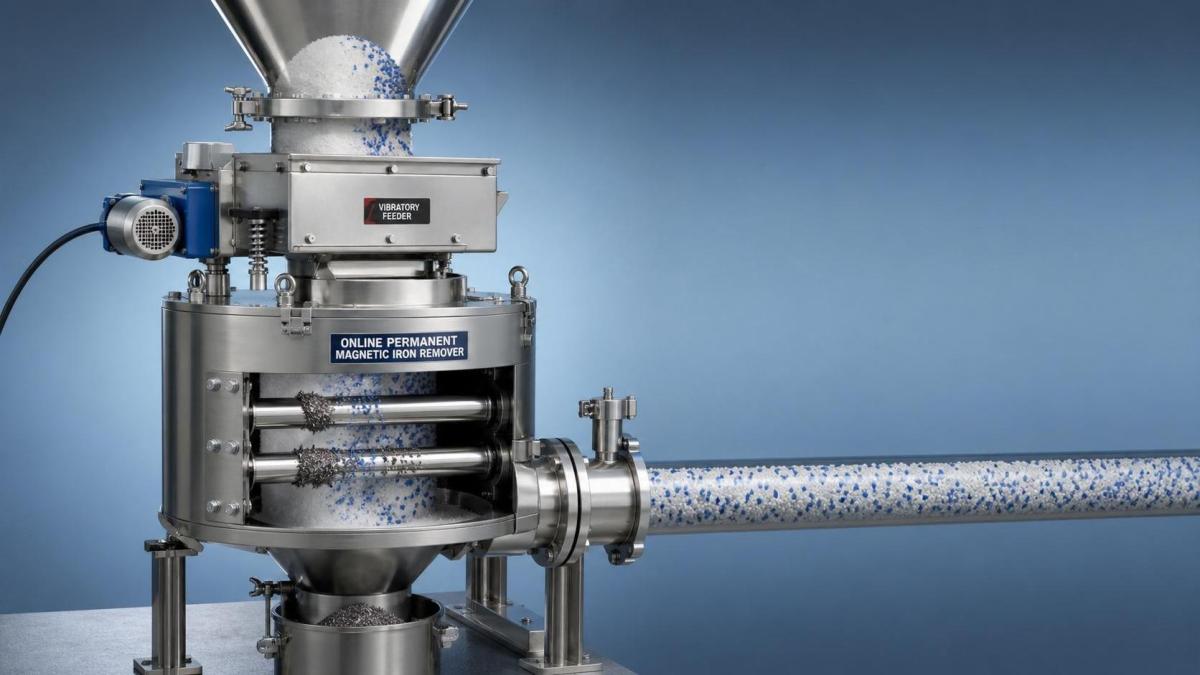
In powder and granule handling, ferrous contamination rarely creates only one problem.
It can damage conveyors, upset metering accuracy, wear mixers, and reduce final product consistency.
That is why an inline permanent magnetic iron separator is often treated as a process protection point, not just an accessory.
In real production lines, however, the right use of an inline permanent magnetic iron separator depends on where contamination enters and how material moves.
A free-flowing plastic granule behaves differently from damp mineral powder or abrasive cement-related material.
This difference affects separator position, magnetic strength expectations, cleaning frequency, and pressure on upstream and downstream equipment.
Companies working across magnetic separation, conveying, vibration feeding, and batching systems often see this clearly in multi-stage plants.
Different lines ask different things from the same separator
The same inline permanent magnetic iron separator can serve very different goals depending on the line section.
Near raw material intake, the focus is usually equipment protection.
Closer to blending, dosing, or packaging, purity and quality stability become more important.
This is where many installations go wrong.
A unit chosen only by pipe size or throughput may fit mechanically, yet still miss the real contamination pattern.
More practical evaluation usually includes material bulk density, particle size range, flow mode, moisture, iron particle size, and cleaning access.
Where fine powders usually need a different judgment
Fine powders often create the most demanding conditions for an inline permanent magnetic iron separator.
Material can bridge, cling, or compact around magnetic elements, especially when moisture or static is present.
In cement additives, mineral powder, and similar bulk solids, contamination may also be very fine.
That means magnetic reach alone is not enough.
The separator must be placed where the powder is distributed evenly across the flow path.
If material channels through one side of a chute, capture performance becomes inconsistent.
In actual use, vibration feeding and controlled dosing upstream can improve separation stability as much as the magnet itself.
This is one reason integrated line thinking matters in plants using conveyors, vibrators, and batching systems together.
What deserves attention in powder service
- Whether powder stays loose enough to expose iron particles to the magnetic field.
- Whether maintenance access allows regular cleaning without long production stops.
- Whether abrasive material will shorten service life of internal contact surfaces.
- Whether the separator adds unacceptable pressure drop or flow restriction.
Granule handling often shifts the priority toward flow continuity
Granules usually flow more easily, but that does not make separator selection simpler.
In resin pellets, compound feed, fertilizer granules, or pre-mix materials, line continuity often becomes the deciding factor.
The inline permanent magnetic iron separator must capture metal without creating hang-up points that disturb throughput.
Here, the risk is not usually powder compaction.
It is uneven residence time, particle bounce, or bypass if the flow speed is too high.
A common mistake is assuming that larger particle size means easier separation in every case.
If ferrous fragments are thin, light, or moving quickly in a dense stream, they may still escape capture.
In these lines, orientation and residence path are often more important than simply increasing magnetic intensity.
The biggest mistakes usually happen before installation
Several misjudgments appear repeatedly across powder and granule systems.
- Choosing by nominal capacity, while ignoring actual peak load and material surges.
- Comparing only purchase cost, while overlooking cleaning labor and shutdown time.
- Treating similar products as identical, although moisture or particle shape has changed.
- Installing too far downstream, after metal has already reached sensitive equipment.
- Expecting one separator to solve both coarse tramp iron and very fine contamination equally well.
These errors are avoidable when site conditions are reviewed as part of the whole transfer and processing route.
A practical way to match the separator to the line
A useful selection process starts with contamination source mapping.
Look at raw material origin, upstream wear points, maintenance history, and any steel contact surfaces.
Then confirm how the line really behaves during stable operation and during upset conditions.
For many general industrial spare parts systems, the best result comes from checking five items together.
- Material state: dry, damp, free-flowing, sticky, abrasive, or mixed-size.
- Flow path: gravity drop, pneumatic transfer, screw feed, or belt-to-chute transition.
- Contamination profile: coarse fragments, wire-like pieces, or fine iron dust.
- Service pattern: continuous line, batch operation, or frequent recipe change.
- Maintenance reality: available access, cleaning interval, and spare part replacement timing.
Once those points are clear, the inline permanent magnetic iron separator can be matched more accurately to the line instead of to a catalog description.
Turning scene-based judgment into the next step
The value of an inline permanent magnetic iron separator becomes clearer when the application is judged by process position, material behavior, and maintenance limits together.
That approach reduces unexpected downtime and avoids overdesign where simpler protection would work.
A sensible next step is to review contamination sources, compare powder and granule flow conditions, and define the capture goal at each transfer point.
For lines that need a closer reference, this can be compared with the structure and application logic of an In-Line Magnetic Separator before confirming layout, maintenance rhythm, and compatibility with surrounding conveying or batching equipment.
Search from here
Get Free Quotes