



‹
›
‹
›
Air Box Pulse Jet Bag Dust Collector
Product Details
Product Overview
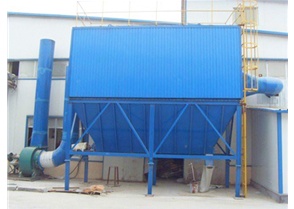
The air box pulse jet baghouse dust collector is a new type of pulse jet baghouse dust collector. It combines the advantages of various baghouse dust collectors, including compartment reverse-air cleaning and pulse jet cleaning, while overcoming the shortcomings of weak cleaning intensity in compartment reverse-air cleaning and the need for simultaneous cleaning and filtration in pulse jet cleaning. This expands its range of applications.
This product features compartment-based overall cleaning, using large-scale electromagnetic pulse valves for cleaning. It offers strong cleaning capability, excellent cleaning effectiveness, and long service life. The product is suitable for treating high-concentration dust, simplifying the dust treatment process flow and reducing equipment investment. The compact structure requires minimal floor space, reducing construction investment. It delivers significant environmental, social, and economic benefits, filling a domestic gap in air-pulse cleaning technology and achieving a domestic leading level.
Structural Components
The air box pulse jet baghouse dust collector consists of the following components:
(1) Housing Section: Includes the clean air chamber (also known as the gas purification box or air box), filtration chamber, compartment partition plates, access doors, and housing structure. The clean air chamber contains poppet valves, tube sheets, and injection pipes. The filtration chamber contains filter bags and bag cages.
(2) Hopper and Dust Discharge Mechanism: Includes the hopper and, depending on the series and inlet dust concentration, screw conveyors, air slides, and rotary feeders (discharge valves).
(3) Inlet/Outlet Air Box: Includes the inlet/outlet air ducts and a middle partition plate. For single-row (single-column) configurations, this is arranged on one side of the housing. For double-row (double-column) configurations, it is arranged in the middle of the housing. The A series (smaller size) has no air box; the inlet and outlet air ducts are connected directly to the hopper and clean air chamber.
(4) Pulse Cleaning Device: Includes pulse valves, air reservoir, cylinders for poppet valves, and solenoid valves.
(5) Compressed Air Piping and Accessories: Includes pressure reducing devices, oil-water separators, and oil mist lubricators.
(6) Supports and Vertical Cage Ladders/Railings: Includes support columns, vertical cage ladders, and handrails.
Working Principle
Dust-laden gas enters from the air inlet of the inlet/outlet air box (for the A series, it enters from the hopper), turns through the inclined baffle plate, and enters the hopper. At the same time, the gas velocity decreases. Due to inertial forces, coarse dust particles in the gas fall into the hopper, while fine dust particles turn upward with the airflow and enter the filtration chamber. Dust attaches to the outer surface of the filter bags. The purified gas passes through the filter bags into the upper clean air chamber. The gas from each compartment's clean air chamber is collected and discharged through the air outlet, then drawn out by the dust collection system's main fan and exhausted into the atmosphere.
As filtration continues, dust accumulation on the outer surface of the filter bags gradually increases, causing increasing resistance to airflow. When the resistance reaches a certain value (e.g., 1990 Pa), the cleaning cycle can be initiated manually or automatically via a constant-pressure or constant-time pulse control instrument. The control system automatically closes the poppet valve of one compartment, cutting off the airflow through that filtration chamber. It then opens the electromagnetic pulse valve to release high-pressure compressed air, performing pulse jet cleaning on all filter bags in that compartment's air box (offline cleaning). This causes each filter bag to suddenly expand, dislodging the dust accumulated on the bag surface and restoring the pressure differential to its initial state. The dislodged dust falls into the hopper.
The programmable controller then opens the poppet valve at a preset time interval, restoring filtration in that compartment. It then closes the poppet valve of the next compartment, cutting off filtration airflow in that compartment, and opens the electromagnetic pulse valve of that compartment to release high-pressure compressed air, performing offline pulse jet cleaning on all filter bags in that compartment. This process continues sequentially for the third, fourth, and subsequent compartments. After the last compartment has been cleaned, the controller completes the cycle, and all compartments return to normal filtration operation.
Specifications
The air box pulse jet baghouse dust collector is available in four series with 33 specifications. Filtration area ranges from 93 to 4,361 m², and air handling capacity ranges from 6,900 to 314,000 m³/h. It is widely used in building materials, cement, metallurgy, machinery, chemical, and refractory industries. It is particularly suitable for dust collection systems in cement plants, including crushing, packaging, silo tops, clinker coolers, and various mills. It can also be used for coal mill dust collection, but with additional fire and explosion protection measures and corresponding structural modifications. It is also suitable for collecting dust from gases with extremely high dust concentrations, such as in grinding systems with O-Sepa separators, where the dust concentration can exceed 1,000 g/Nm³, eliminating the need for a separate cyclone pre-dust collector. For severe cold regions in northern China, this dust collector can be adapted by adding heating and insulation devices.
Structure
This is a modular, compartment-structure baghouse dust collector that uses electromagnetic pulse valves on top of each compartment to perform offline pulse cleaning (i.e., offline cleaning) on the filter bags of each compartment in rotation. It differs from conventional pulse jet baghouse dust collectors, which perform online cleaning by injecting pulses row by row within the same filtration compartment while other rows continue filtering. In online cleaning, cleaning and filtration occur simultaneously in the same compartment, causing dislodged dust to re-enter the airflow, with some being re-collected by adjacent filter bags. This is less effective for filtering gas with high dust concentrations. The PPC series air box pulse collector performs cleaning with the poppet valve closed, stopping filtration in that compartment, and also allows filter bags in one compartment to be replaced without shutting down the entire system.
Recommended Products
Search from here
Get Free Quotes