


‹
›
‹
›
Twin-Shaft Mixer
Product Details
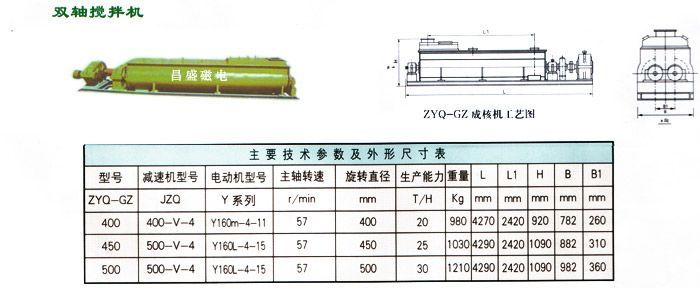
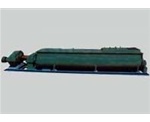
Twin-Shaft Mixer / Double Shaft Paddle Mixer
The twin-shaft mixer (also known as a double shaft paddle mixer) is an industrial equipment that utilizes two parallel, counter-rotating shafts to efficiently mix, blend, or condition bulk materials. It is widely used in industries such as building materials, chemical, metallurgy, feed, food, and environmental protection.
The core structure consists of two horizontally parallel mixing shafts, mixing paddles (or blades) mounted at specific angles on the shafts, a drive unit (motor and gearbox), a housing (U-shaped trough or cylindrical), and inlet/outlet ports. During operation, the two shafts rotate in opposite directions driven by the gearbox. The paddles force the material to move along the inner wall of the trough while also causing it to tumble and flow laterally. In the overlapping zone between the two rotors, a "weightless zone" is created where particles float or are gently thrown, subjecting them to intense shearing, convection, and diffusion, achieving high uniformity in a very short time.
Depending on the application, twin-shaft mixers are available in several types:
Twin-Shaft Paddle Mixer (for dry blending): Used for high-precision mixing of powder-powder or powder-liquid. Features short mixing cycles (typically 30–120 seconds), high homogeneity (CV ≤ 5%), and low residue discharge.
Twin-Shaft Mixer (for conditioning/dust control): Commonly used for humidifying fly ash, sand, ore, etc., to prevent dust emission during transport, with capabilities for quantitative feeding and uniform moisture addition.
Dual-Shaft Multifunctional Dispersing Mixer: Equipped with a high-speed dispersing disc and a low-speed scraping anchor agitator, suitable for high-viscosity pastes, sealants, inks, and similar materials.
Key features include:
High Mixing Efficiency: The counter-rotating shafts and specially designed paddles achieve homogeneous mixing in just 45–60 seconds.
High Uniformity: Achieves segregation-free mixing even for materials with significant differences in specific gravity and particle size, with a coefficient of variation below 5%.
Strong Adaptability: Wide filling range (25%–100%), ability to add liquids, and capability to handle sticky materials.
Fast Discharge, Low Residue: Full-length drop-bottom discharge ensures rapid emptying with minimal residue.
Energy Efficient: Optimized fluid dynamics and efficient drive systems reduce energy consumption by 30%–60% compared to traditional equipment.
The mixer can be constructed from carbon steel, 304, or 316L stainless steel, with surface finishes up to sanitary grade (Ra ≤ 0.3μm). Optional features include explosion-proof motors, liquid dosing systems, and heating/cooling jackets. Capacities typically range from tens of liters to over ten thousand liters.
Typical Applications:
Building Materials/Cement: Humidifying and conveying fly ash, slag, furnace slag
Metallurgy/Chemicals: Mixing and pelletizing sinter, pellets, fertilizers, pigments
Feed/Grain: Blending premixes, complete feeds, grains (powder/granular)
Food/Pharmaceutical: High-sanitary mixing of food additives, pharmaceutical powders, spices
Environmental Protection: Sludge solidification, fly ash treatment from waste incineration, FGD gypsum processing
Recommended Products
Search from here
Get Free Quotes