



How to Audit an Electric Vibrator Manufacturer for Quality Control Consistency
Why does auditing an electric vibrator manufacturer matter so much?

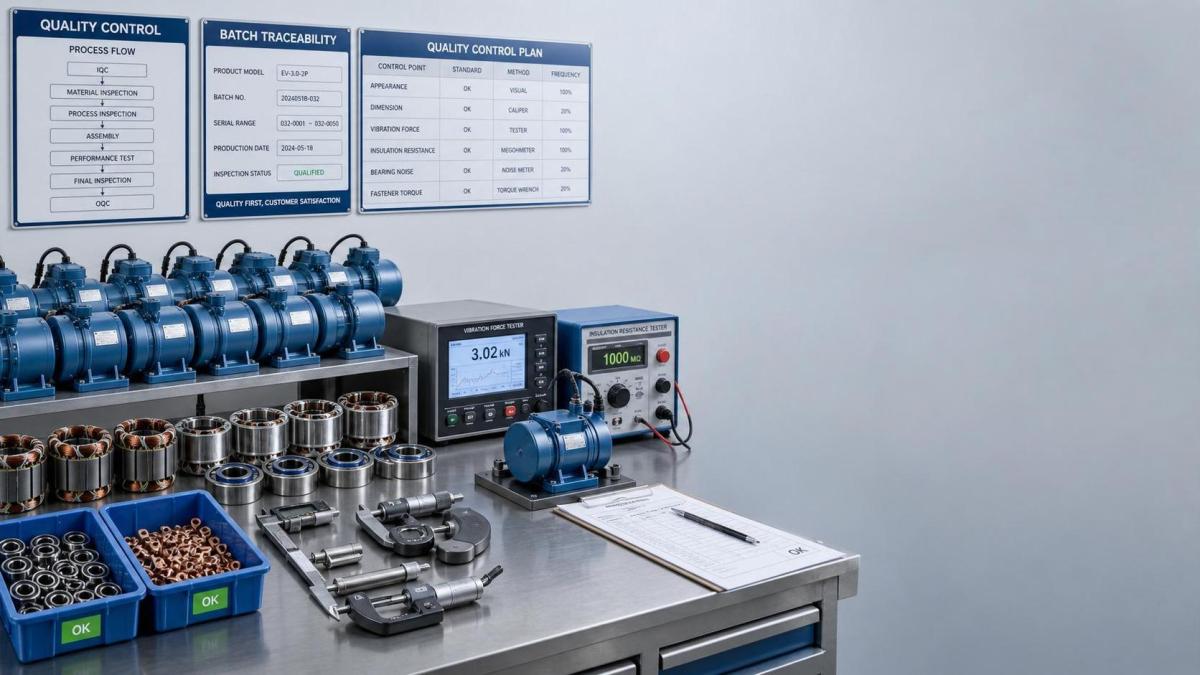
A supplier review is not only about sample approval. It is about verifying whether an electric vibrator manufacturer can deliver the same quality every batch.
That matters in general industrial parts, where unstable vibration force, overheating, or loose assembly can affect safety, uptime, and downstream process control.
In practice, the stronger audit focuses on process consistency. You need to see how materials are controlled, how critical parameters are checked, and how nonconforming units are isolated.
For companies working across magnetic equipment, conveyors, batching systems, and electric vibrators, consistency usually depends on disciplined production routines rather than one good-looking inspection report.
What should you look at before the factory tour starts?
A useful audit begins with documents. If the paperwork is weak, the shop floor often tells the same story.
Start by requesting the quality manual, incoming inspection standards, process flow chart, control plan, and final test records for the electric vibrator manufacturer.
Then check whether part numbers, motor specifications, insulation class, bearings, fasteners, and coils can be traced to approved suppliers and batch lots.
The next question is simple: do the records match actual production? A mature factory can connect drawings, routing cards, test sheets, and shipment labels without confusion.
If document versions differ between engineering and production, that is an early warning sign. It usually means process changes are happening without controlled review.
A quick document check often reveals these risks
Which production points tell you whether quality is really consistent?
The most revealing part of the audit happens on the line. A capable electric vibrator manufacturer should control a few critical points very tightly.
- Coil winding consistency, including wire specification, turns, insulation treatment, and curing conditions.
- Rotor and eccentric block balance, because imbalance affects noise, vibration amplitude, and bearing life.
- Fastener torque control, especially at mounting points and terminal connections.
- Bearing installation method, lubrication standard, and contamination control.
- Final run testing under defined voltage, load condition, temperature, and duration.
More importantly, ask how out-of-spec data is handled. Good factories stop the process, investigate root cause, and record corrective action.
Less reliable sites often retest until a unit passes. That approach hides variation instead of controlling it.
How do you judge testing standards and compliance without relying on claims?
Certification helps, but it is only the starting point. The better question is whether the electric vibrator manufacturer can show repeatable test evidence tied to each shipment.
Review electrical safety checks such as insulation resistance, grounding continuity, and dielectric strength where applicable. Also review mechanical checks like vibration force, noise, temperature rise, and running stability.
If the factory serves heavy-duty industrial applications, ask whether it separates standard testing from customer-specific validation. That distinction matters when operating conditions are harsh.
A useful follow-up is to compare three recent batches. Look for similar test ranges, not just pass marks. Stable data usually says more than a polished certificate.
What records should be easy to retrieve?
- Raw material batch numbers and supplier source
- Assembly operator and production date
- In-process checkpoints and rework history
- Final inspection values and release approval
- Complaint handling and corrective action closure
What are the most common audit mistakes when comparing suppliers?
One common mistake is focusing too much on price and sample appearance. A clean sample does not prove a stable manufacturing process.
Another mistake is treating all factories the same. Some suppliers have strong fabrication ability but weak process discipline, while others have better control systems and clearer traceability.
It is also risky to ignore field feedback. An electric vibrator manufacturer may pass internal tests yet still show recurring loosening, abnormal heat, or short bearing life in service.
A more practical comparison uses three filters: process capability, consistency evidence, and response speed when problems appear.
In real projects, this usually reduces supply risk more effectively than choosing only by quoted cost or lead time.
So what does a solid audit conclusion actually look like?
A strong conclusion is specific. It should identify which controls are stable, which gaps affect risk, and what evidence is still missing.
That may include follow-up actions such as a pilot order, tighter acceptance criteria, periodic batch review, or an on-site re-audit after corrective action.
For industrial equipment suppliers with a broader product range, including magnetic separators, conveyors, and metering systems, this wider manufacturing background can help when process control is applied consistently across product lines.
If you are reviewing a long-term source, build your checklist around traceability, critical process control, testing repeatability, and nonconformance handling. That is usually where supplier quality either holds or breaks.
As a next step, compare your audit findings against related material-handling equipment standards and adjacent components. For example, when evaluating integrated plant equipment, it can be useful to review products such as MW84 Series Lifting Electromagnet for Steel Plate to see whether the same discipline in traceability, testing, and production control extends across the supplier’s portfolio.
Search from here
Get Free Quotes