



How to Select a Magnetic Separator for Mining Based on Ore Type and Throughput
How to Select a Magnetic Separator for Mining Based on Ore Type and Throughput
Choosing the right magnetic separator for mining can directly impact recovery efficiency, operating costs, and project timelines.
When ore properties and plant capacity do not match the equipment, separation results usually suffer first.
That often leads to higher recirculation loads, unstable output, and avoidable downtime.
A practical selection process should connect ore type, throughput, installation limits, and maintenance needs.
This guide breaks down how to choose a magnetic separator for mining with fewer assumptions and better project control.
Start With Ore Type, Not Equipment Catalogs
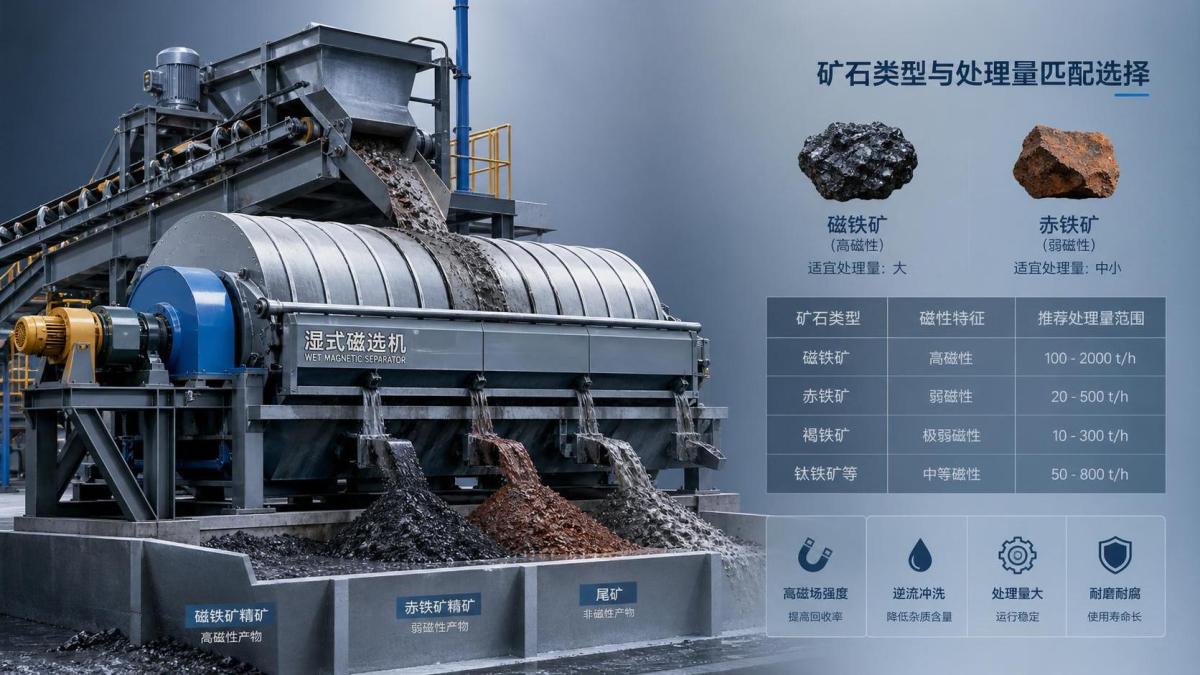
Ore type is the first filter when selecting a magnetic separator for mining.
Different minerals respond to magnetic fields in very different ways.
Magnetite is strongly magnetic and usually easier to recover.
Hematite, limonite, and manganese ores often need higher field intensity or staged separation.
If the ore contains gangue with similar particle behavior, selectivity becomes more important than raw magnetic strength.
In practice, review these ore characteristics before comparing models:
- Magnetic susceptibility of target minerals
- Particle size distribution after crushing or grinding
- Moisture level and slurry concentration
- Liberation degree of valuable minerals
- Clay content and risk of material adhesion
This step prevents an expensive mismatch later in the project.
Match Separation Method to the Processing Stage
The right magnetic separator for mining also depends on where it sits in the process flow.
A roughing stage usually favors capacity and stable removal.
A cleaning stage usually demands better grade control and tighter separation accuracy.
Dry separators often suit coarse, dry material and pre-concentration tasks.
Wet magnetic separators are more common for fine particles and slurry-based beneficiation lines.
Electromagnetic systems can offer stronger and more adjustable field intensity.
Permanent magnetic systems often reduce power consumption and simplify daily operation.
This comparison helps narrow the field before detailed technical review.
Use Throughput Data to Avoid Undersized or Oversized Selection
Throughput is where many selection decisions become risky.
A magnetic separator for mining should not be chosen only by peak tonnage on paper.
You need actual operating throughput, material fluctuation range, and future expansion assumptions.
If capacity is too small, residence time drops and recovery can fall quickly.
If capacity is too large, investment cost and energy use may climb without real benefit.
A better approach is to calculate selection around three numbers:
- Nominal hourly throughput
- Maximum short-term loading
- Expected throughput after process optimization
That creates room for stable production without buying unnecessary equipment size.
It also makes vendor comparisons more realistic and easier to defend internally.
Check Site Conditions Before Final Approval
Even a well-matched magnetic separator for mining can underperform if site conditions are ignored.
Installation space, power stability, water availability, and upstream feeding consistency all matter.
From recent project changes, tighter footprints are becoming more common.
That means equipment layout should be reviewed together with conveyors, feeders, and discharge points.
Pay attention to these practical checks:
- Will feed rate stay uniform enough for stable separation?
- Is there enough clearance for maintenance access?
- Can the control system support field adjustment and monitoring?
- Are wear parts and service support locally available?
These details often decide whether performance stays consistent after commissioning.
Compare Total Operating Value, Not Only Purchase Price
Price matters, but it should not lead the full decision.
The better question is how the magnetic separator for mining performs across the whole operating cycle.
A lower-cost unit may create higher losses through poor recovery or frequent cleaning stops.
A stronger system may reduce waste, improve concentrate quality, and shorten payback time.
When reviewing proposals, compare:
- Recovery efficiency under your ore conditions
- Power consumption per ton processed
- Maintenance frequency and downtime impact
- Wear life of key components
- Supplier response speed and technical support depth
This creates a more reliable basis for procurement and project scheduling.
Build a Smarter Selection Flow
A solid decision usually follows a simple sequence.
- Define ore type, particle size, and target minerals.
- Confirm process stage and separation objective.
- Check nominal and peak throughput requirements.
- Review utilities, layout, and maintenance conditions.
- Compare lifecycle value across shortlisted options.
- Request testing data or pilot validation whenever possible.
For operations planning line upgrades, stable feeding should also be part of the discussion.
That is why related material handling equipment deserves attention early.
If feed consistency is affecting separation efficiency, consider pairing the system with an Electromagnetic Vibrating Feeder.
Weifang Yuansheng Magnetic & Electrical Equipment Co., Ltd. provides magnetic separation and conveying solutions that support more stable plant performance.
In the end, the best magnetic separator for mining is the one that fits your ore, your throughput, and your operating reality.
Search from here
Get Free Quotes